That’s about enough posts on sexism in Orthodox Tradition, don’t you think? Let’s turn to a more palatable topic.
 |
| No, I said palatable |
 |
| Closer... |
 |
| TOO FAR. GO BACK |
Shun the apostate!
I have a confession to make. I received Communion at a Methodist church this morning. And on Orthodox Easter too! Oh how far I have strayed.
Receiving Communion at any non-Orthodox church is strictly forbidden to Orthodox Christians. That makes me officially Not In Good Standing with the Orthodox Church, in case I wasn’t already a pariah for neglecting to receive Communion for over a year, publicly criticizing a priest, and (worst of all) listening to Pussy Riot.
 |
| I guess I'm a sucker for angry female vocals |
The Lord’s Snack Time
I was aware that today was Communion Sunday, but as I walked up the steps to the church I still hadn’t decided whether I was going to participate.
The Orthodox heart that still stubbornly beats in my chest suffered temporary arrhythmia the moment I entered the church, when an usher held out a basket of what I can only describe as Eucharistic snack packs.
 |
| They're only missing a trademarked cartoon character |
The Communion-To-Go cups were right there in the open for anyone and everyone to grab as they walked in. The usher didn’t ask any questions about your church affiliation or whether you had fasted that morning or the state of your soul. No one’s fingers trembled as they reached into the basket.
My 5-year-old immediately wanted to eat his. The usher joked, “Sorry, you have to wait until snack time.” His joke struck me as being very close to the truth. We had to hang onto them until the end of the service, so I just set them beside me on the pew, where they sat next to my purse and the order of worship like they were ordinary objects.
Everyone was treating the Holy Gifts as if they were mere grape juice and wafers-- because, of course, that’s what they were. The Body and Blood of Christ existed only in the minds of the communicants, who saw no impropriety in their handling of the lowly, material signifier.
This anti-materialist, "symbol only" approach to Communion is not totally alien to me. I grew up in the Southern Baptist church, where the Lord's Supper usually took the form of Styrofoam-flavored discs and thimbles of grape juice served in brass trays. Individually packaged wafers and juice are just the logical next step. During the COVID-19 pandemic, sanitation concerns have greatly increased demand for these all-in-one snack packs “Fellowship Cups.”
The Mystical Supper
In contrast, Orthodox Christians believe that the Bread and Wine truly become the Body and Blood of Christ. Well, what does that even mean?
 |
| “THEY JUST DO, OK” —St. John of Damascus |
Unlike Catholics, the Orthodox have no dogmatic formulation to explain exactly how the material elements of the Eucharist become the Body and Blood of Christ. They only insist that it is real, mystical, not merely symbolic.
Orthodox practice reflects this doctrine. There are a lot of rules about who may receive Communion, and when and how they may receive it. From a Protestant point of view, these rules probably seem unnecessarily restrictive; what right does the Church have to keep anyone away from the Lord's Table? From an Orthodox point of view, the rules are necessary to protect the Holy Gifts from mishandling-- and to protect would-be communicants from the spiritual and physical consequences of receiving the Holy Gifts unprepared.
A few of the rules:
- Only members of the Orthodox Church who have recently been to Confession, have no grave unconfessed sins on their consciences, and have fasted since midnight may partake.
- No one but the priest touches the Holy Gifts with his hands. The faithful all receive from a single communal spoon, which the priest dips into the chalice containing the intermingled Bread and Wine.
- When a communicant approaches, the priest’s assistants hold a red cloth between the chalice and the communicant’s chin, lest any precious drops should fall to the floor. Proper form is to open one’s mouth wide so that the priest can transfer the Holy Gifts without actually touching the spoon to the lips.
- When all the faithful have Communed, the priest consumes what remains in the chalice. It would be unthinkable to throw it out like last week’s leftover lasagna.
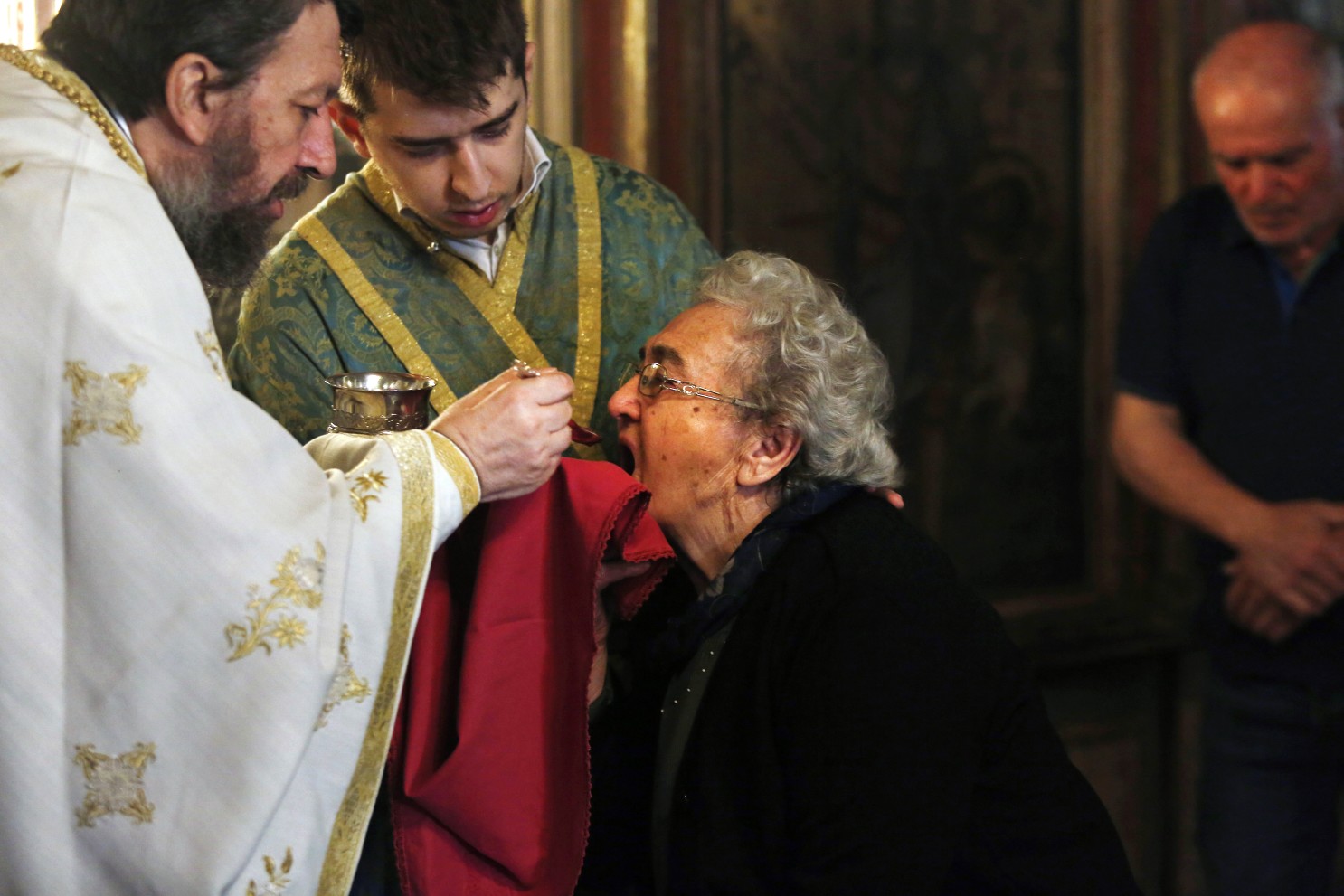
I can hear my non-Orthodox readers saying, “One spoon? Ewww! Gross!” Indeed, the Orthodox communal spoon became a subject of controversy during the pandemic when the Orthodox Church refused to modify its practice.
Our old friend Fr. Josiah Trenham, human incarnation of the Grumpy Orthodox Cat meme, stirred the pot when he delivered a sermon condemning Orthodox who fear using the shared spoon due to COVID concerns:
[A]nd if you have a thought at all, “Oh my gosh, someone who was sick went up and took the Eucharist off the same spoon, I shouldn’t go,” banish the thought from your mind. It is a thought of unbelief sent from the devils. If you can’t banish it, by no means approach Communion, then or ever, because you are unworthy. You do not believe in the life-giving Eucharist if that is a thought that you actually embrace.
Fr. Trenham, along with several of his parishioners, later tested positive for COVID. Thanks be to God, he appears to have recovered, since he continues to post inflammatory sermons on his podcast The Arena.
 |
| That means I can make fun of him again. |
As usual, Fr. Trenham’s statement was unnecessarily judgmental but otherwise not far outside standard Orthodox belief. How could the Eucharist, the Fountain of Immortality which heals our souls and bodies, transmit illness?
A devout Orthodox Christian might still wonder: does the mystical anti-microbial property of Holy Gifts extend to the spoon, the cup, the cloth, the icons, and the cheeks of our fellow parishioners?
 |
| The Orthodox really like to kiss stuff |
Is there no room for altering non-essential aspects of Church practice without denying the real presence of Christ in the Eucharist? Some Orthodox argue that there is, noting that Orthodox practice (not doctrine) regarding the Eucharist has evolved throughout the Church’s history to meet the needs of the time.
So, who’s right?
If you’re asking which form of Holy Communion the Lord prefers, heck if I know. I hope, in any case, that He forgives us for imperfect celebration of His Sacraments, or else we are all in trouble.
As an English Lit major, though, I can't help but critique the symbolism embedded in the various Eucharistic forms. I think symbolism matters, whether in a novel, a poem, or real life. I think it works on us whether we know it or not, and whether the symbolism is intentional or not.
I think the symbolism of the wafers and juice thimbles is all wrong. The Lord’s Lunchables Fellowship Cups are even worse. I understand the pragmatic appeal, but they're individualistic and sterile, the very opposite of communal. We the Universal Church are supposed to be one Body— Christ’s Body.
I consumed my merely symbolic grape juice and wafer today, anyway. Grumpy Orthodox Cat would definitely disapprove. But I hope God will be pleased that, after a year of abstaining from Communion, I tried to find a way back to His Table—however hesitantly I did it and however inelegant the form. I’d like to believe that our Lord, Who descended all the way down to Hell and conquered it, can reach me where I am.
Surely this Methodist church is at least a few levels above Hell?
Kidding. I really like this new church we been visiting, despite their cringey Dunkaroos Fellowship Cups. They have an organ and they play traditional hymns.
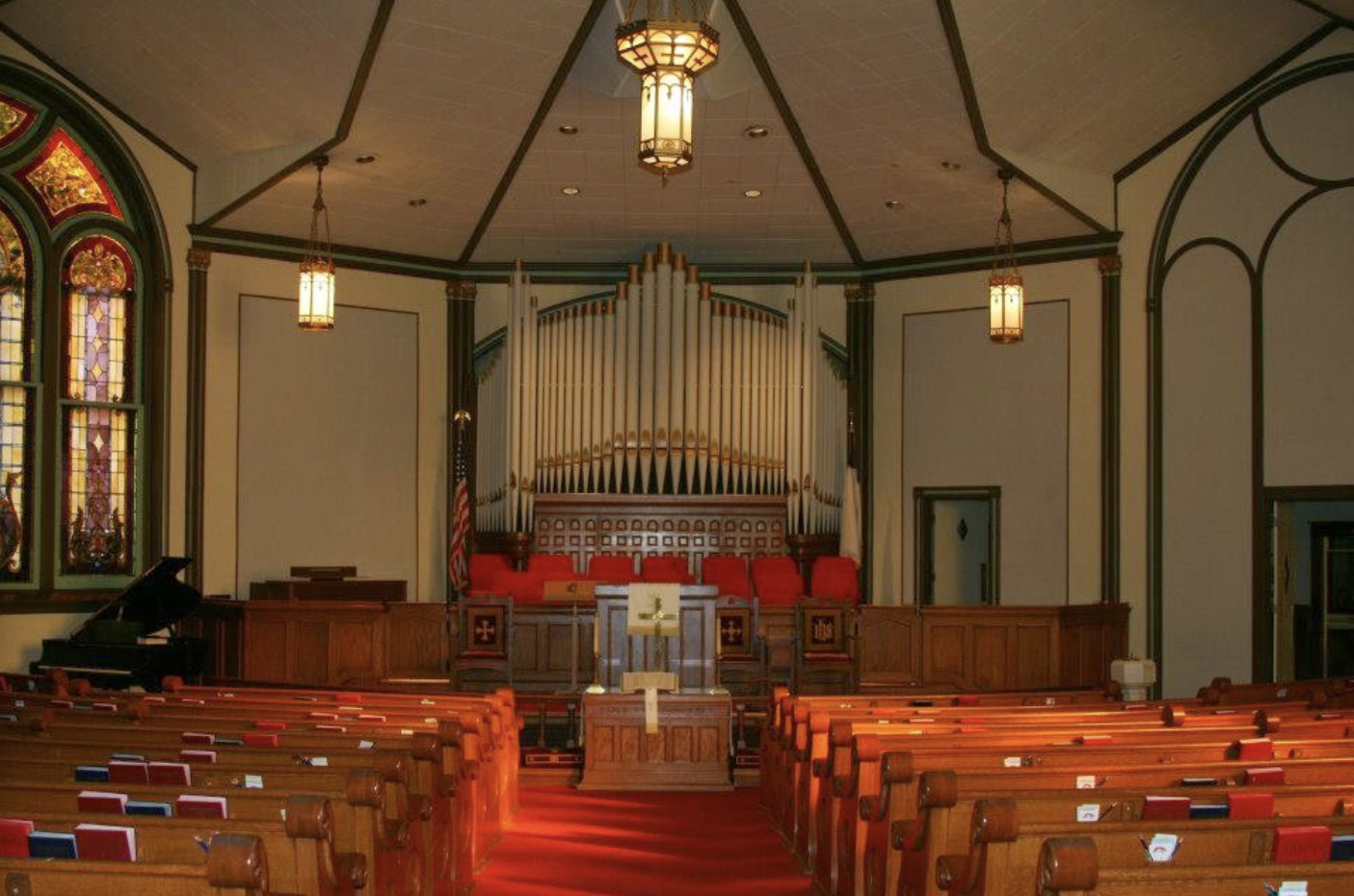 |
| I can deal with the snack packs as long as I get to sing “Christ the Lord Is Risen Today” on Easter |
Good Bread
Christian belief and practice is diverse, so I’m sure there are many methods of celebrating Communion besides the ones at Orthodox, Methodist, and Baptist churches that I’ve attended.
I once got a taste of an entirely different Communion service when I was a volunteer in a Catholic Worker soup kitchen. It was the last time I received Communion outside of an Orthodox Church, up until today. Despite the name, the organization was not particularly Catholic. What I remember most vividly is the bread: a big, round, marbled loaf fresh from the soup kitchen’s oven. We passed it around and tore off chunks with our hands.
In retrospect, I think this experience combined the openness of the Methodist Communion with the solemnity of the Orthodox Eucharist. I touched the Bread with my own bare hands, but I believed it was more than just bread. No one demanded proof of membership, but I felt connected with everyone else there. We were literally breaking bread, eating from the same loaf. It probably helped that we were all there laboring together in Christian service.
I think the bread itself had something to do with why this experience of Communion was so powerful to me. It mattered that the bread was GOOD bread. When Jesus performed His first miracle, He didn’t just turn water into wine— He turned it into GOOD wine. The wedding guests had already gotten sloshed on Barefoot when He brought out the Louis Jadot. (That’s the fanciest wine label I know of, sorry. You get the point.)
I’m just saying, if Christ Himself has good taste, maybe we should too. Good bread might be good for our souls.


